
PTNAI Münchwilen

Our core competence in the PTNAI department is the scaling of processes from research to production. The Chemical Process Development begins once new chemical compounds with promising biological effects have been identified in laboratories and greenhouses. For the first time, we produce new active substance in larger quantities of several hundred kilograms at our Münchwilen site. This quantity is used to support the development of the formulated end-products and conduct extensive studies on environmental compatibility, biological behavior, and potential toxicological properties within the Crop Protection sector. The results of these studies are crucial for the regulatory registration and market launch of the products.
Chemical & Process Engineering
The transfer of a chemical process from the laboratory to the pilot plant and then to chemical production is always a challenge for a team of well-trained collaborators. In developing a cost-effective, robust production process, several groups within Process Development work closely together; the Chemical Process team in the lab is completed by a group of engineers and a Process Science group. The group of process engineers determines and optimizes the parameters of distillations, filtrations or continuous reactions and tests special equipment. Together with the development of chemical processes, concepts for the recovery of energy and raw materials are developed, which contribute to reducing waste. The active substances processes for all Syngenta crop protection products worldwide are developed in Münchwilen.


ESA Engineering capability
Environmental Sustainability Assessment (ESA) is crucial in support of Syngenta’s environmental responsibility. Using Life Cycle Assessment (LCA), we quantify environmental impacts of our processes and portfolio. While there are many impact categories, our initial focus is on climate change. LCA supports us in measuring greenhouse gas emissions, enabling us to set reduction targets for our existing processes and portfolio in alignment with global initiatives such as the Paris Agreement. LCA is also being used within Syngenta to design more environmentally friendly processes.
Although currently focussed on climate change, the LCA methodology provides a foundation for assessing other environmental impact categories in the future.
Process Technology - Bench Lab
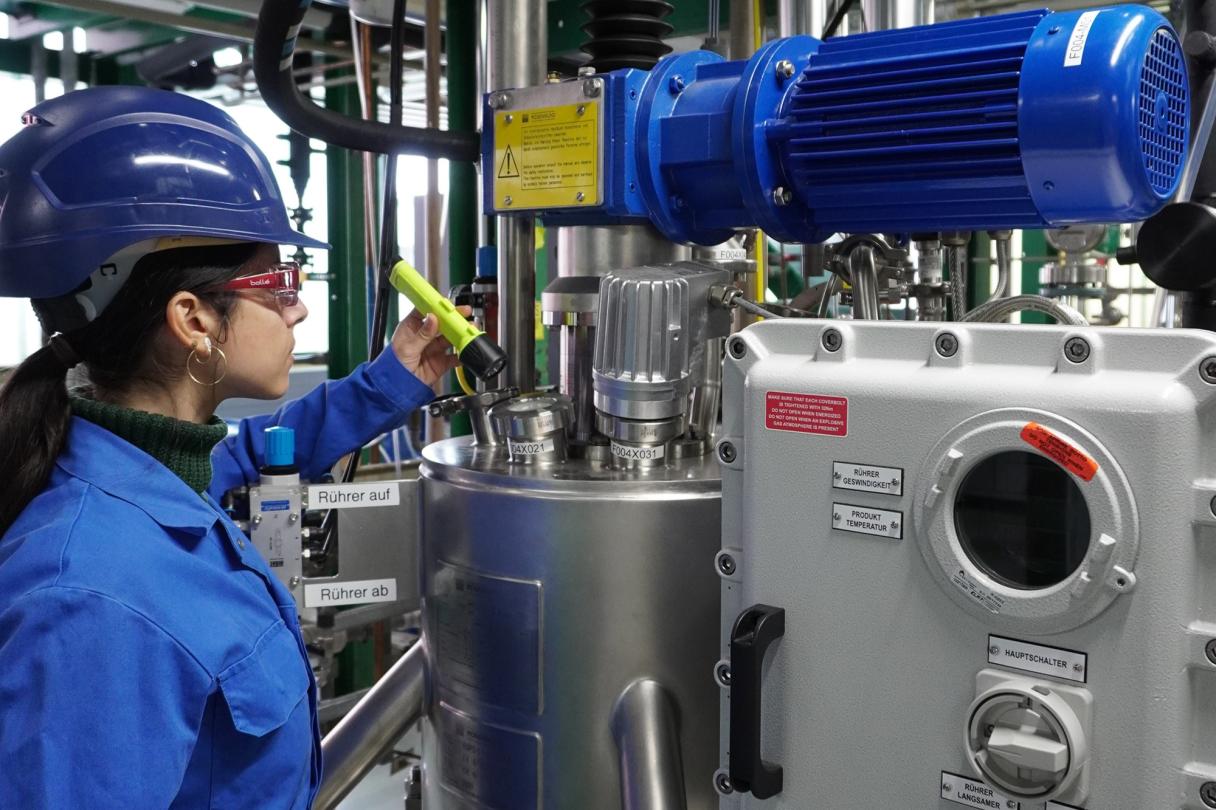
Our PTNAI Bench Lab is a valuable resource in scaling up of processes in Münchwilen. With reactors at 20 to 50L scale and scaled down versions of pilot distillation, filtration and drying equipment, specific scale up questions or risks can be investigated and assessed. This facility also provides a space to test new technologies, such as photochemistry, and continuous options on a representative scale with higher flexibility and lower material requirements. Our main tasks of the Bench Lab are therefore scale up/down studies, five Typical Batch campaigns and testing of process variants and new technologies.

Process Technology - Lab
Our work in the Chemical Process Development department begins after research chemists and biologists have identified a new chemical active ingredient with promising biological effects in laboratories and greenhouses. To produce larger quantities in the pilot plant, we must generate a wide range of information in the laboratory regarding safety, cost efficiency, scalability, waste streams, and the type of technology to be used on-scale. We maintain close contact with other departments such as Analytics, Formulation, Regulatory Affairs, and many others, as this is of great importance to satisfy all needs as best as possible.
Process Technology -
Pilot Plant
The Synthesis Pilot Plant serves as the key link between technical process development and introduction of new development products into full scale manufacturing environments at our global production sites. This critical step in the product life cycle is enabled by prototyping (“piloting”) new synthesis processes with both established as well as novel technologies. With its wide range of readily available and modular equipment up to the 4000 Liter scale, our Synthesis Pilot Plant thus transports laboratory scale processes onto a miniaturized manufacturing scale and continuous the journey of process development and optimization. In this context also the first large quantities of new development products are furnished, which are integral to continued product development. Consequently, in our pilot plant, we bring an innovative product to initial production on an unprecedented scale on average every six weeks.
